TECHNICAL DATA SHEET
Durabak Indoor Technical Data Sheet
Aromatic (MDI) Moisture-Cured Polyurethane Coating - Textured and Smooth
Download PDF (this document) ← Back to Technical Information
1. Product Description
Durabak Indoor is a single-component, moisture-cured polyurethane coating formulated for indoor, shaded, submerged, and non-sunlight applications. It is NOT UV stable. In direct or prolonged sunlight the coating will amber and fade; for any permanent outdoor or UV-exposed installation use Durabak-18 Outdoor/UV instead.
The chemistry is aromatic (MDI, 4,4'-diphenylmethane diisocyanate). Curing occurs by reaction with atmospheric moisture; no mixing, no catalyst, and no induction time are required. The Textured grade contains self-contained recycled rubber granules that create a high-traction surface profile when applied with a stipple roller. The Smooth grade omits granules and is intended for applications where traction profile is unnecessary or where a lower-build film is preferred.
Durabak bonds chemically to properly prepared steel, painted or sound-coated metal, aluminum, concrete, wood, fiberglass, rubber, most rigid plastics, and cured epoxy or primer. The coating is flexible, waterproof, and bonds to itself, making spot repair and recoating straightforward without removing the original film.
2. Recommended Uses / Features and Benefits
Recommended Uses
Suitable for indoor and shaded environments where UV stability is not required:
- Indoor pedestrian walkways, ramps, loading docks, and freight elevators
- Truck bed liners (covered or shaded storage use; for open beds in daily sun exposure use Durabak-18 Outdoor/UV)
- Ship and vessel interior decks, passageways, gangways, and piping
- Pools, spas, and submerged or wetted areas
- Storage tanks, concrete floors, and industrial decking
- Metal and wooden steps, catwalks, bridges, and roofing (shaded/covered areas)
- Vehicle undercoating
- Sealing corroded or rusty pipe surfaces (prime bare steel first)
- Playgrounds, tool handles, curb ramps, and parking lots (covered structures)
Features and Benefits
- One-part system. No mixing, no pot-life pressure once the can is sealed. Reseal immediately after each pour.
- Moisture-cure. Cures by atmospheric moisture, not a catalyst. Higher relative humidity speeds cure; condensation or standing water on the surface is not the same and must be avoided before application.
- Textured slip resistance. The Textured grade, applied with a stipple roller, achieves a static coefficient of friction of 0.95-0.98 dry and 1.41 wet (ASTM D1894). A separate ASTM D2047 reading gives 1.21 dry / 0.67 wet. Smooth grade is NOT slip-rated.
- Flexibility. The cured film remains flexible: elongation 497% (ASTM D2370); passes 1/8 inch mandrel bend with no cracking (ASTM D522). Resists cracking and impact across a service temperature range of -60 F to +254 F.
- Repairability. Bonds to itself. Spot-repair or recoat indefinitely after light abrasion -- no removal of the existing film required.
- Chemical and water resistance. 100% salt-water resistance; passes 7-day water immersion with no effect (ASTM D1308); salt spray no effect (ASTM B117 / D610). See Section 8 for the full chemical resistance table.
- Low abrasion loss. 30.5 mg weight loss, Taber abraser, 1000 g load, 1000 cycles (ASTM D4060).
- Fire test data. Flame spread index 01 (ASTM E-162); smoke density 06 (ASTM E-662). Not a fire rating; reported as tested values.
- Low VOC. 250 g/L (2.08 lb/gal).
- NOTE: NOT UV STABLE. This product ambers and fades in direct sunlight. For outdoor, UV-exposed, or permanently sun-facing surfaces, specify Durabak-18 Outdoor/UV (IPDI aliphatic chemistry).
3. Product Data / Physical Properties
| Property | Textured | Smooth | Test Method / Notes |
|---|---|---|---|
| Chemistry / binder | MDI aromatic polyurethane | MDI aromatic polyurethane | Aromatic; NOT UV stable |
| Curative (isocyanate) | 4,4'-MDI (101-68-8), <5.3% | 4,4'-MDI (101-68-8), <5.3% | Respiratory sensitizer; see Section 12 |
| Solvent (primary) | Xylene (CAS 1330-20-7) | Xylene (CAS 1330-20-7) | Aromatic solvent; 20-30% by weight (see composition note below) |
| Solvent constituent | Ethylbenzene (CAS 100-41-4) | Ethylbenzene (CAS 100-41-4) | 5-10%; constituent of the aromatic (xylene) solvent |
| Components | 1 (single-pack) | 1 (single-pack) | No mixing required |
| Cure mechanism | Moisture-cure (atmospheric) | Moisture-cure (atmospheric) | Generates CO2 on cure |
| Finish | Textured (rubber-granule profile) | Smooth (no granules) | |
| Liquid density | 1.03 g/cm3 at 20 C | 1.03 g/cm3 at 20 C | ASTM D1475 |
| Weight (packaged) | approx. 10 lb/gal | approx. 10 lb/gal | Filled-can packaged weight |
| Viscosity (mixed) | 67-72 KU (Krebs) | 67-72 KU (Krebs) | Krebs Viscous Meter |
| Solids by weight | 66% | 66% | ASTM D1475 |
| Solids by volume | 75.8% | 75.8% | ASTM D2697 |
| VOC | 250 g/L (2.08 lb/gal) | 250 g/L (2.08 lb/gal) | EPA Test Method 24 |
| Flash point | 27 C (80.6 F) | 27 C (80.6 F) | ASTM D56 |
| Gloss (smooth) | n/a | approx. 84.7% | ASTM D523 |
| pH | approx. 8.0 | approx. 8.0 | |
| Boiling point | 140 C | 140 C | Solvent fraction (xylene) |
| UV stability | NOT UV stable -- ambers/fades in sun | NOT UV stable -- ambers/fades in sun | Use Durabak-18 for UV-exposed surfaces |
| Service temp range | -60 F to +254 F | -60 F to +254 F | Freeze-thaw cycling; constant heat to 254 F |
| Shelf life | 12 months (unopened) | 12 months (unopened) | Store 32-104 F, sealed |
Solids by weight: 66% (confirmed by current datasheet and Navy ASTM F-718). Volume solids: 75.8% (source: current Durabak Company datasheet).
4. Surface Preparation
Surface must be clean, dry, and free of oil, grease, wax, dust, mildew, and loose material. Adhesion fails on contaminated surfaces; solvent-wipe before mechanical prep if oils or mold-release agents are present.
| Substrate | Minimum Preparation | Primer | Notes |
|---|---|---|---|
| Steel (bare or rusty) | Abrasive blast to SSPC-SP 11; 2-4 mil anchor profile (Testex Tape); touch-up SSPC-SP 2 | DuraPrime EP-90 2-part epoxy primer (approx. 70 sq ft/gal; VOC <=80 g/L) | Do not apply to bare steel without primer; rust-inhibitive zinc phosphate spray for touch-up |
| Painted/sound-coated metal | Scuff-sand all glossy surfaces; clean | Prime if coating is thin or questionable | Test adhesion on a small area first |
| Aluminum | Scuff-sand; degrease | Etch primer (NS5 Metcote, approx. 145 sq ft/qt) | 30 min dry before overcoat at 77 F; heat resistant to 428 F |
| Concrete | Remove laitance; acid-etch or grind; must be dry (moisture-meter check) | Prime if porous or carbonated | Allow 30 days cure for new concrete |
| Wood | Sand to remove gloss; dry thoroughly | Prime if highly porous | Pressure-treated lumber: allow weathering; resin bleed-out will prevent adhesion |
| Fiberglass | Sand to dull the surface; degrease | Primer optional; test adhesion | Mold-release wax must be fully removed |
| Rubber (sound) | Scuff-sand; degrease | Not required | Test adhesion first |
| Rigid plastics | Scuff-sand; degrease | Test adhesion first | Not suitable for glass, marble, or polished stone |
| Cured epoxy / primer | Light abrasion; clean | Not required | Good bond substrate |
| Glass, polished stone, or any non-scuffable surface | NOT SUITABLE | NOT SUITABLE | No mechanical key available; coating will not adhere |
For Navy / military surface preparation: follow NAVSEA Standard Items 009-32 and 009-26; conductivity per Bresle Patch Method.
5. Application
Environmental Conditions
All conditions must be met before and during application. Do not apply if any condition is out of range; the cure and adhesion will be compromised.
| Parameter | Required Range |
|---|---|
| Ambient air temperature | 32 F to 95 F |
| Substrate temperature | 45 F to 90 F |
| Dew-point rule | Substrate surface must be at least 5 F ABOVE the dew point |
| Relative humidity | Normal ambient humidity drives cure; avoid condensation or standing water on the surface |
| Substrate condition | Dry; no frost, ice, or surface moisture |
Higher relative humidity accelerates cure. Applications in hot, dry conditions slow dry-to-recoat time.
Mixing and Handling
Stir thoroughly before use and between coats. Do NOT shake the can; shaking entrains moisture and air, which can trigger premature surface cure and foam the film. Reseal the can immediately after each pour. Working/open time after opening: approximately 3 hr at 25 C (4 hr at 20 C, 6 hr at 10 C).
Application Tools
| Method | Tool Specification | Best For |
|---|---|---|
| Roller (Textured) | Stipple roller sleeve (open-foam, phenolic core) | Textured non-slip profile; standard application |
| Roller (Smooth) | 3/16 in short-nap mohair varnish roller | Smooth finish; lower build per pass |
| Brush | Soft paint brush; apply two coats at right angles | Edges, cut-in, small areas |
| Airless spray | 0.021-0.023 in tip; approx. 2.9 gpm class (e.g., Graco Bulldog 33:1); 90-100 psi inlet, approx. 3000 psi outlet | Large areas; no heated lines required; no plural-component equipment |
Conventional spray (e.g., Binks 2001) is also acceptable. No heated lines and no plural-component equipment are required.
Coats and Dry Film Thickness (DFT)
Apply a minimum of two coats.
| Variant | Wet Film Thickness per Coat | Dry Film Thickness per Coat | Total DFT (2 coats) | Measurement Standard |
|---|---|---|---|---|
| Textured or Smooth | 17-25 mils | -- | 29-39 mils | Durabak Company datasheet (primary) |
Primary DFT: 29-39 mils total (2 coats) per the current Durabak Company datasheet. Alternative measured value: 12-18 mils per coat; 24-35 mils total (Navy ASTM F-718, SSPC-PA 2). Consult the live product page for any updated commercial spec.
Coverage
| Variant | Coverage per Gallon | Coverage per Quart |
|---|---|---|
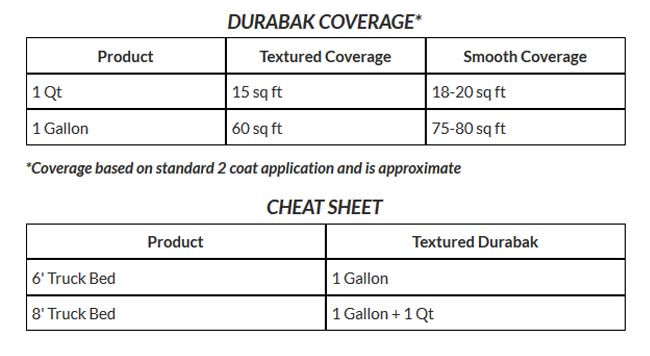
| Textured | 60 sq ft (at 2 coats) | 15 sq ft |
| Smooth | 75 sq ft (at 2 coats) | 18 sq ft |
Coverage is practical coverage at the rubber-granule textured profile. Actual coverage varies with surface porosity, roughness, and application technique.
Accelerator
An optional cure-accelerator additive is available from Durabak distributors. Use 1 packet per quart or 1 packet per gallon. The accelerator shortens cure time by up to 50% with no change to cured-film performance properties. Do not exceed the recommended dose.
6. Thinning / Reducer
Thinning is not normally required or recommended. If viscosity reduction is needed for spray application in cold conditions, use only an approved reducer:
| Reducer | Notes |
|---|---|
| Solvide (Oxsol 100 / Fluidar) | VOC-exempt; approved for all 50 states including California and Utah; preferred reducer |
| Xylene / Xylol | Approved thinner; NOT sold to customers in California or Utah (state regulatory restriction applies to the thinner product, not to the Durabak coating itself) |
Do NOT use generic lacquer thinner, acetone, MEK, or any unapproved solvent. Unapproved solvents alter viscosity unpredictably, can affect moisture-cure reaction rate, and may void product performance data.
Add reducer in small increments with stirring. Over-thinning reduces DFT and solids deposition per coat.
7. Dry / Recoat / Cure Schedule
Times are approximate at 70-75 F and 50% relative humidity. Higher humidity and warmer temperatures shorten times; cooler temperatures and low humidity lengthen them.
| Stage | Time (typical conditions) | Notes |
|---|---|---|
| Tack / flash-off | 1.5-3 hr | Surface dry to light touch; not ready to recoat |
| Touch dry | 1.5-3 hr | Dry to light touch; not yet ready for foot traffic |
| Recoat window -- earliest | approx. 1 hr (light tack) | Apply second coat as soon as first is touch-dry |
| Recoat window -- nominal | 6-12 hr | Preferred recoat window for full intercoat adhesion |
| Recoat window -- maximum | 24 hr | Beyond 24 hr, abrade the surface before recoating to restore adhesion bond |
| Full cure / return to service | 4 days (full cure; allow longer at cooler temperatures or low humidity) | |
| Working / open time (per open can) | 3 hr at 25 C | 4 hr at 20 C; 6 hr at 10 C; reseal promptly |
If the recoat window is missed (>24 hr), lightly sand the surface with 80-120 grit, remove dust, and proceed. Do not skip this step; adhesion between coats depends on it.
8. Performance and Test Data
Physical Performance
| Property | Result | Test Method |
|---|---|---|
| Abrasion resistance | 30.5 mg weight loss | ASTM D4060 (Taber abraser, 1000 g load, 1000 cycles) |
| Slip resistance -- Textured dry | Static CoF 0.95-0.98 | ASTM D1894 |
| Slip resistance -- Textured wet | Static CoF 1.41 | ASTM D1894 |
| Slip resistance -- Textured dry (alternate) | CoF 1.21 | ASTM D2047 |
| Slip resistance -- Textured wet (alternate) | CoF 0.67 | ASTM D2047 |
| Slip resistance -- Smooth | Not slip-rated | n/a |
| Salt spray resistance | No effect | ASTM B117 / D610 |
| Water immersion (7-day) | No effect | ASTM D1308 |
| Flame spread index | 01 | ASTM E-162 |
| Smoke density (specific optical) | 06 | ASTM E-662 |
| Elongation | 497% | ASTM D2370 |
| Mandrel bend | Passes 1/8 inch; no cracking | ASTM D522 |
| Service temperature | -60 F to +254 F | Freeze-thaw cycling; constant heat to 254 F |
| Flash point | 27 C (80.6 F) | ASTM D56 |
| UV / weathering | NOT UV stable -- ambers/fades in direct sun | MDI aromatic chemistry; use Durabak-18 for UV-exposed use |
Note: fire test values are reported as tested results. They do not constitute a fire rating.
Chemical Resistance (7-Day Immersion)
Results from product manual 7-day immersion testing. Ratings: Excellent = no visible effect; Good = minor effect; Fair = moderate effect/check suitability; Poor = significant effect/not recommended.
| Chemical | Rating |
|---|---|
| Potable water | Excellent |
| Salt water | Excellent |
| Dilute acids | Excellent-Good |
| Alkalis | Excellent-Good |
| Diesel fuel | Good |
| Gasoline | Fair |
| Acetone | Poor |
| Concentrated chlorine | Discolors if not rinsed off immediately |
Concentrated industrial-strength chlorine will discolor the surface if left in contact. Rinse off immediately. Use non-chlorinated cleaners for routine maintenance.
9. Clean-Up
Clean tools and equipment immediately after use. Cured Durabak is extremely difficult to remove.
| Cleaner | Notes |
|---|---|
| Solvide (Oxsol 100 / Fluidar) | Preferred; VOC-exempt; 50-state legal |
| Xylene / Xylol | Effective; NOT sold to CA or UT (thinner restriction) |
Dispose of solvent waste in accordance with local, state, and federal regulations. Do not pour solvent or coating residue into drains or waterways. Refer to the paired SDS for disposal guidance.
10. Storage and Shelf Life
| Parameter | Specification |
|---|---|
| Shelf life (unopened) | 12 months from date of manufacture |
| Storage temperature | 32 F to 104 F |
| Storage condition | Sealed; dry area; away from heat, sparks, and open flame |
| Humidity | Keep moisture out of the can; reseal immediately after each use |
| Freeze | Do not allow to freeze |
This is a moisture-cure product. Any exposure of the liquid to atmospheric moisture (open can, improperly resealed lid, humid storage) will reduce working life and can cause surface skinning or gellation. Reseal the can immediately after each pour.
11. Packaging and Colors
Packaging
| Size | Coverage (Textured) | Coverage (Smooth) |
|---|---|---|
| Quart | 15 sq ft (2 coats) | 18 sq ft (2 coats) |
| Gallon | 60 sq ft (2 coats) | 75 sq ft (2 coats) |
Standard Colors
Textured (16 colors): black, dark grey, light grey, brick red, bright red, military olive, white, brown, dark blue (vivid), orange, tan, light blue, sand, forest green, yellow, cream.
Smooth (15 colors): black, bright red, clear/colorless, cream, dark blue (vivid), dark grey, forest green, light blue, light grey, military olive, orange, sand, tan, white, yellow.
Custom color matching is available at a 75-gallon minimum order with lead time. Colors are also hand-mixable by the user. The indoor (MDI) and outdoor (IPDI) grades look identical once applied; label stored containers.
12. Limitations and Health / Safety
Limitations
- NOT UV stable. Durabak Indoor (MDI, aromatic) will amber and fade with prolonged direct sun or UV exposure. For outdoor, UV-exposed, or permanently sun-facing surfaces, use Durabak-18 Outdoor/UV (IPDI, aliphatic). If the indoor product has already been applied to a sun-exposed surface, topcoating with a UV-stable clear coat or UV rejuvenator can extend cosmetic life but does not make the underlying film UV stable.
- Not suitable for glass, marble, polished stone, or any surface that cannot be mechanically abraded to provide a mechanical key.
- Not certified or suitable for potable-water contact or potable-water submersion.
- Concentrated chlorine contact must be minimized; rinse off immediately to prevent discoloration.
- Recoating beyond the 24-hour maximum window requires mechanical abrasion before applying the next coat.
- Apply only within the temperature, dew-point, and humidity limits stated in Section 5.
VOC
VOC: 250 g/L (2.08 lb/gal). Sold in California. CARB SCM-compliant as an Industrial Maintenance coating at <=250 g/L VOC. NOT available in the SCAQMD (greater Los Angeles) district or other air districts that enforce a 100 g/L Industrial Maintenance limit.
MDI Respiratory Sensitizer -- Ventilation Callout
This product contains 4,4'-diphenylmethane diisocyanate (MDI, CAS 101-68-8) at less than 5.3% by weight. MDI is a known respiratory sensitizer (GHS H334: may cause allergy or asthma symptoms or breathing difficulties if inhaled) and a suspected carcinogen (GHS H351). Repeated or high-level inhalation exposure may cause sensitization, after which even very low concentrations can trigger severe asthmatic reactions.
Ventilation requirements:
- Ensure adequate mechanical ventilation during application and until the coating is tack-dry.
- In confined spaces or enclosed areas, use supplied-air respiratory protection (airline respirator or SCBA). A half-face respirator with organic-vapor/P100 combination cartridges is the minimum for general ventilation conditions.
- MDI (101-68-8) US OELs: OSHA PEL -- none established; ACGIH TLV 0.005 ppm (0.051 mg/m3) TWA; NIOSH REL 0.005 ppm TWA / 0.020 ppm ceiling.
- Spray application generates the highest inhalation exposure; respiratory protection is mandatory for spray in any condition.
- Keep bystanders out of the application area until the coating is tack-dry.
Xylene (CAS 1330-20-7, 20-30% by weight) is also present. US OELs: OSHA PEL 100 ppm (435 mg/m3) TWA; ACGIH TLV 100 ppm TWA / 150 ppm STEL. Ethylbenzene (CAS 100-41-4) US OELs: OSHA PEL 100 ppm (435 mg/m3) TWA; ACGIH TLV 20 ppm TWA.
Personal Protective Equipment (PPE)
Minimum PPE during application:
- Respiratory: Half-face respirator with organic-vapor / P100 cartridges for brush/roller in ventilated areas; supplied-air for spray or confined spaces.
- Skin: Chemical-resistant gloves (nitrile or neoprene); long sleeves.
- Eyes: Chemical splash goggles.
- Clothing: Remove and wash contaminated clothing before reuse.
California Proposition 65
WARNING: This product can expose you to ethylbenzene, which is known to the State of California to cause cancer. For more information go to www.P65Warnings.ca.gov.
Flammability
Flash point 27 C (80.6 F), ASTM D56. Classified Flammable Liquid, GHS Category 3 (H226). Keep away from heat, sparks, open flame, and hot surfaces. No smoking. Ground and bond metal containers during transfer. Extinguish with dry chemical, CO2, foam, or water fog. Do not use direct water stream on burning liquid.
Additional Regulatory
- TSCA: All components are active or exempt on the US TSCA Inventory. TSCA 8(a) PAIR and 8(c) SAR records apply to MDI.
- Clean Air Act 112(b) HAPs: xylene and ethylbenzene are listed.
- Clean Water Act: 307 priority pollutant = ethylbenzene; 311 hazardous substance = xylene, ethylbenzene.
- SARA 302/304: No extremely hazardous substances present; reportable quantity not applicable.
- SARA 313: ethylbenzene (CAS 100-41-4) and xylene (CAS 1330-20-7) are listed toxic chemicals subject to supplier notification; applicable threshold reporting may apply.
- State right-to-know: xylene, ethylbenzene, and diisocyanate/MDI are listed under Massachusetts, New Jersey, New York, and Pennsylvania RTK laws.
- International inventories: all components listed or exempt in Australia, Canada, China, Japan (CSCL), Republic of Korea, New Zealand, Philippines, Taiwan, EU/Eurasian (Russia), Vietnam, and United States.
- Transport: UN1263 / PAINT / Class 3 (Flammable Liquid) / Packing Group III; not a marine pollutant.
Consult the paired Safety Data Sheet before use.
13. Disclaimer / Warranty
The information in this Technical Data Sheet is based on tests and data believed to be accurate and is provided as a guide for proper product use. Values stated represent typical or average results; normal variations in application conditions, surface preparation, and film build will produce variations in performance.
The applicator is responsible for determining the suitability of this product for any specific application and for ensuring all applicable safety, regulatory, and environmental requirements are met. Durabak makes no warranty, express or implied, beyond the product specifications stated herein. No statement in this document shall be construed as a recommendation to infringe any patent.
Revision date: 2026-06-18
Version: 1.0
Website: durabakcompany.com