TECHNICAL DATA SHEET
Durabak-18 Outdoor / UV Technical Data Sheet
Aliphatic (IPDI) Moisture-Cured Polyurethane Protective Coating
Download PDF (this document) ← Back to Technical Information
1. Product Description
Durabak-18 Outdoor / UV is a single-component, moisture-cured aliphatic polyurethane coating containing recycled-rubber granules (Textured grade) or cast as a smooth film (Smooth and White grades). The curative is isophorone diisocyanate (IPDI, CAS 4098-71-9), an aliphatic isocyanate that resists UV degradation without chalking or yellowing -- the property that distinguishes Durabak-18 from Durabak Indoor, which uses an aromatic MDI curative and is not suitable for sustained sun exposure.
The coating cures by reaction with atmospheric moisture and releases carbon dioxide as a by-product. No mixing, no catalyst, and no pot-life countdown are required for normal use. An optional accelerator (sold separately) shortens cure time. The cured film is abrasion-resistant, slip-rated in Textured grades, fuel- and chemical-resistant, and bonds to most prepared substrates.
Formulation type: One-part (single-pack) moisture-cured aliphatic polyurethane.
Curative: IPDI (aliphatic; UV stable).
Finish options: Textured (recycled-rubber granules) | Smooth | White.
2. Recommended Uses and Features & Benefits
Primary applications
- Truck bed liners (roll-on or brush)
- Marine decks, boat hulls below the waterline, dock surfaces
- RV roofs and exterior panels
- Automotive undercoating and wheel-well protection
- Industrial and commercial floors subject to foot traffic, vehicle traffic, and chemical exposure
- Any outdoor surface requiring a durable, UV-stable, slip-resistant finish
Features and benefits
| Feature | Detail |
|---|---|
| UV stable | Aliphatic IPDI curative; resists chalking and yellowing under prolonged sun exposure |
| Slip-rated (Textured) | Recycled-rubber granules embedded in the wet film; ASTM D1894 / D2047 coefficients of friction on file |
| Abrasion resistant | Taber abrasion 30.5 mg weight loss at 1,000 g load / 1,000 cycles (ASTM D4060) |
| Chemical and salt resistant | 100% salt-water resistance; salt-spray test no effect (ASTM B-117 / D-610); 7-day immersion data available (see Section 8) |
| One-part convenience | No mixing; moisture-cure; no pot life under normal use |
| Bonds to most substrates | Steel, aluminum, concrete, wood, fiberglass, rubber, rigid plastics, cured epoxy/primer |
| Spot repairable | Bonds to itself; recoatable after light abrasion |
| Elongation / flexibility | 497% elongation (ASTM D2370); passes 1/8 inch mandrel bend with no cracking (ASTM D522) |
| Wide service temperature | -60 F to +254 F, including freeze-thaw cycling |
Variant summary
| Grade | Finish | Coverage (2 coats) | Slip-rated |
|---|---|---|---|
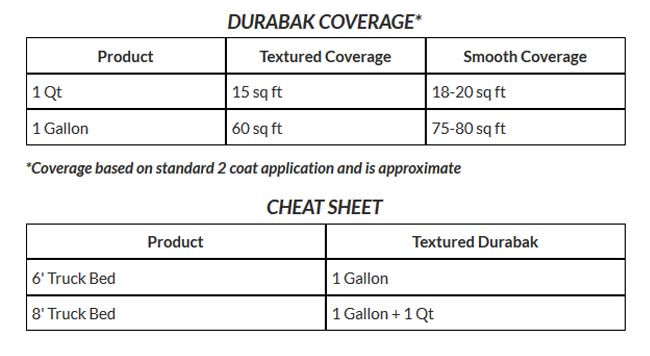
| Textured | Granule rubber texture | 60 sq ft/gal (15 sq ft/qt) | Yes |
| Smooth | No granules; semi-gloss | 75 sq ft/gal (18 sq ft/qt) | No |
| White | Smooth; white pigment | 75 sq ft/gal (18 sq ft/qt) | No |
Coverage is practical coverage at the rubber-granule textured profile; actual coverage varies with surface porosity and application method.
3. Product Data / Physical Properties
Composition (hazardous constituents above reporting thresholds)
| Constituent | CAS | Approximate % | Notes |
|---|---|---|---|
| Xylene (mixed isomers) | 1330-20-7 | 30-60% | Solvent carrier |
| Ethylbenzene | 100-41-4 | 5-10% | Constituent of the aromatic (xylene) solvent |
| Isophorone diisocyanate (IPDI) | 4098-71-9 | (see SDS) | Aliphatic curative; UV stable |
Physical properties
| Property | Value | Test method |
|---|---|---|
| Type | One-part moisture-cured aliphatic polyurethane | -- |
| Curative | Isophorone diisocyanate (IPDI, CAS 4098-71-9) | -- |
| Liquid density | 0.985 g/cm3 at 20 C (approx. 8.2 lb/gal) | ASTM D1475 |
| Packaged weight (approx.) | approx. 10 lb/gal (filled container) | -- |
| Flash point | 27 C (80.6 F) | ASTM D56 |
| pH | ~8.0 | -- |
| Viscosity (product spec) | 67-72 KU (Krebs) | -- |
| Viscosity (uncured liquid, SDS) | 80-110 KU (Krebs) at 20 C | -- |
| Solids by weight | 66% | per Navy F-718 + Durabak Tests & Data |
| Solids by volume | 75.8% | -- |
| VOC | 250 g/L (2.08 lb/gal) | -- |
| Boiling point | 140 C | -- |
| Decomposition temperature | 200 C | -- |
| Auto-ignition temperature | >200 C | -- |
| Physical state | Liquid | -- |
| Odor | Mild sweet / solvent | -- |
| Service temperature | -60 F to +254 F (freeze-thaw cycling) | -- |
| Gloss (Smooth grade) | ~84.7% | -- |
| Abrasion resistance | 30.5 mg weight loss | ASTM D4060 (Taber, 1,000 g, 1,000 cycles) |
| Elongation | 497% (ASTM D2370); passes 1/8 inch mandrel bend with no cracking (ASTM D522) | ASTM D2370 / D522 |
| Shelf life (unopened) | 12 months at 32-104 F | -- |
Wet film thickness (per coat): 17-25 mils.
Dry film thickness: 29-39 mils total (2 coats) (per Durabak Company datasheet).
Footnote: The Navy ASTM F-718 / SSPC-PA 2 dossier gives a measured alternative of 12-18 mils per coat; 24-35 mils total (2 coats).
4. Surface Preparation
Proper surface preparation is the single largest variable in adhesion and service life. Do not skip abrasion on any sound but glossy substrate.
By substrate
| Substrate | Preparation required |
|---|---|
| Bare steel / iron | Remove all loose rust, scale, oil, and grease. Abrade to minimum SSPC-SP3 (power tool) or SP6 (commercial blast). Apply DuraPrime EP-90 epoxy primer or Zinc Phosphate primer before topcoat. Bare unprimed steel is not recommended for sustained immersion service without a primer. |
| Rusty or pitted steel | Wire-brush or grind to remove loose material. Spot-prime with Zinc Phosphate spray, then apply EP-90 over the full panel before Durabak-18. |
| Painted / sound-coated metal | Remove loose, peeling, or chalking paint. Scuff-sand the remaining sound paint to break gloss (80-100 grit). Wipe clean. Durabak-18 bonds to sound, abraded paint. |
| Aluminum | Degrease with solvent wipe. Scuff-sand (80-100 grit) or etch-prime with NS5 Metcote (dries 30 min at 77 F). Oxide layer must be removed or disrupted before topcoat. |
| Concrete | Clean, dry, and free of oil, curing compounds, and laitance. Acid-etch or grind to open the surface. Allow to dry fully (moisture reading). Concrete moisture content must be below the substrate-temp / dew-point limit stated in Section 5. |
| Wood | Dry (below 15% MC), clean, sanded to 80 grit. Knots and resinous areas: spot-seal with shellac or epoxy sealer. |
| Fiberglass / GRP | Degrease. Scuff-sand the gelcoat or existing finish (80-120 grit). Wipe off sanding dust. No primer required on well-abraded gelcoat. |
| Rubber | Clean and degrease. Light scuff with 80-120 grit. Durabak-18 bonds well to cured EPDM and neoprene. |
| Rigid plastics (most) | Clean, degrease, scuff-sand. Adhesion varies by plastic type; test an inconspicuous area. Polyethylene, polypropylene, and other low-surface-energy plastics: standard abrasion will not bond; flame/plasma treatment or a dedicated adhesion promoter is required, and a test patch is essential. |
| Cured epoxy / primer | Scuff-sand (120 grit) if more than 24 hours old. No additional primer needed. |
What Durabak-18 will NOT bond to: glass; marble and polished stone; any non-porous, non-abraded surface that cannot be scuffed to a dull, open profile.
5. Application
Environmental conditions
| Condition | Requirement |
|---|---|
| Ambient air temperature | 32 F to 95 F |
| Substrate temperature | 45 F to 90 F |
| Substrate-to-dew-point margin | Substrate surface must be at least 5 F above the dew point |
| Humidity | Normal ambient humidity drives cure. Avoid standing water or condensation on the surface. Higher humidity accelerates cure. |
| Standing water | Do not apply over wet or damp surfaces |
Equipment
| Method | Equipment / tip |
|---|---|
| Brush | Natural or synthetic bristle; suitable for cut-in, edges, and small areas |
| Roller -- Textured grade | Stipple roller sleeve (the stipple sleeve is required to key granules into the film; a standard nap roller will not work) |
| Roller -- Smooth grade | 3/16 in short-nap mohair roller |
| Airless spray | Tip: 0.021-0.023 in; approx. 2.9 gpm class (e.g., Graco Bulldog 33:1) |
Technique
- Stir thoroughly before use. Do not shake the can -- shaking entrains moisture and air bubbles. Reseal the can immediately after each pour.
- First coat: apply a uniform film at the wet film thickness target of 17-25 mils. Work in one direction. On textured grades, the roller action keys the granules into the wet film.
- Second coat: apply after the first coat reaches the recoat window (see Section 7). Cross-coat direction (perpendicular to the first pass) improves uniformity.
- Minimum 2 coats required to reach the specified dry film thickness of 29-39 mils total.
- Accelerator (optional): add 1 packet of Durabak-18 Accelerator per quart or per gallon immediately before application. Mix thoroughly. The accelerator shortens cure time by up to 50% with no change to cured-film performance.
- Working / open time after opening: approximately 3 hr at 25 C (4 hr at 20 C; 6 hr at 10 C). Reseal the can between coats.
6. Thinning / Reducer
Thinning is not required for most applications. If viscosity needs to be reduced for spray application or warm-weather brushing, use ONLY:
- Solvide reducer -- VOC-exempt; legal in all 50 states including California. This is the recommended reducer.
- Xylene / Xylol -- not sold to California or Utah residents. May be used in other states by operators who have confirmed local VOC compliance. (The VOC restriction applies to the xylene thinner product itself; the Durabak-18 coating VOC is 250 g/L regardless of reducer choice.)
Do NOT use generic lacquer thinner, acetone, MEK, or mineral spirits. These solvents are not approved reducers and can affect adhesion or cure.
Overthinning lowers the solids per coat and reduces dry film build. When thinning for spray, add the reducer in small increments and test on a scrap panel before applying to the work surface.
7. Dry / Recoat / Cure Schedule
Times are at 77 F (25 C) and moderate relative humidity (approximately 50% RH). Higher humidity and higher temperature accelerate cure. Lower temperature and lower humidity extend these times.
| Stage | Time at 77 F / 50% RH |
|---|---|
| Tack / flash-off | 1.5-3 hr |
| Touch dry | ~1.5-3 hr |
| Minimum recoat (light tack) | ~1 hr |
| Nominal recoat window | 6-12 hr |
| Maximum recoat without abrasion | 24 hr |
| Walk-on / dry-to-handle | 6-12 hr |
| Full cure / return to service | 4 days (full cure; allow longer at cooler temperatures or low humidity) |
| Working / open time after opening | ~3 hr at 25 C; ~4 hr at 20 C; ~6 hr at 10 C |
Maximum recoat note: if more than 24 hours elapse between coats, abrade the first coat lightly (120 grit) and wipe clean before applying the next coat. This restores mechanical adhesion.
Accelerator: reduces cure time by up to 50%. Full-cure timeline compresses proportionally; follow the recoat intervals as observed, not the clock alone.
8. Performance and Test Data
Physical and weathering performance
| Property | Result | Test method |
|---|---|---|
| Abrasion resistance | 30.5 mg weight loss (1,000 g load, 1,000 cycles) | ASTM D4060 (Taber abraser) |
| Slip resistance -- static CoF dry (Textured) | 0.95-0.98 | ASTM D1894 |
| Slip resistance -- static CoF wet (Textured) | 1.41 | ASTM D1894 |
| Slip resistance -- CoF dry (Textured, D2047 method) | 1.21 | ASTM D2047 |
| Slip resistance -- CoF wet (Textured, D2047 method) | 0.67 | ASTM D2047 |
| Smooth / White grades | Not slip-rated | -- |
| Salt-spray resistance | No effect | ASTM B-117 / D-610 |
| UV / weathering (500-hr QUV) | Gloss loss only; no cracking or checking | Internal test data |
| Flame spread index | 01 | ASTM E-162 |
| Smoke generation | 06 | ASTM E-662 |
| Service temperature | -60 F to +254 F | -- |
| Water immersion | No effect (7-day) | ASTM D1308 |
Fire test note: the E-162 and E-662 values are tested results, not a fire rating. They do not constitute a UL or NFPA classification.
Chemical resistance (7-day immersion)
Results from the Durabak product manual immersion table. All results at 7-day exposure.
| Chemical / medium | Resistance rating |
|---|---|
| Acids (general) | Excellent to Good |
| Alkalis (general) | Excellent to Good |
| Potable water | Not certified or suitable for potable-water contact or potable-water submersion. |
| Salt water | Excellent |
| Diesel fuel | Good |
| Gasoline | Fair |
| Concentrated chlorine | Discolors if not rinsed promptly -- rinse immediately |
| Acetone | Poor |
"Excellent" = no effect on film. "Good" = minor or no visible effect. "Fair" = minor softening or discoloration on extended exposure; film recovers on drying. "Poor" = significant softening or swelling; avoid prolonged contact.
9. Clean-Up
Uncured material: clean tools and equipment immediately after use with xylene / xylol or Solvide. Once the coating cures, it cannot be dissolved by common solvents.
Cured overspray or drips: mechanical removal (scraping, sanding) only.
Skin contact: remove uncured coating with waterless hand cleaner or Solvide, then wash with soap and water. Do not use xylene as a skin wash. Cured film on skin will wear off over time.
Disposal of spent solvents and rags: comply with local hazardous-waste regulations. Rags and applicators soaked with solvent-thinned coating are combustible -- spread flat outdoors to dry before disposal, or treat as flammable waste.
10. Storage and Shelf Life
- Shelf life (unopened): 12 months from manufacture date, stored at 32 F to 104 F.
- Storage: store sealed in a cool, dry location at 32 F to 104 F. Keep away from heat, sparks, and open flame.
- After opening: moisture cure begins once the can is opened. Reseal promptly and firmly after each use. Purging the headspace with dry nitrogen or argon before resealing extends the in-can life of a partially used container.
- Do not freeze. Freezing will damage the product.
- Signs of degradation: significant viscosity increase, skinning, or gelatinous texture in an opened can indicates moisture contamination; do not use.
11. Packaging and Colors
Packaging
| Size | Coverage (Textured, 2 coats) | Coverage (Smooth/White, 2 coats) |
|---|---|---|
| 1 quart | ~15 sq ft | ~18 sq ft |
| 1 gallon | ~60 sq ft | ~75 sq ft |
Custom quantities available for commercial and fleet orders.
Available colors
Textured (16 colors): black, dark grey, light grey, brick red, bright red, military olive, white, brown, dark blue (vivid), orange, tan, light blue, sand, forest green, yellow, cream.
Smooth (15 colors): black, bright red, clear/colorless, cream, dark blue (vivid), dark grey, forest green, light blue, light grey, military olive, orange, sand, tan, white, yellow.
White grade: available as a smooth finish in both Outdoor/UV and standard formulations.
Custom color matching: available at 75-gallon minimum order with lead time. Colors are also hand-mixable by the user. UV-grade and non-UV-grade products look identical in the can; confirm the SKU before ordering for UV-exposed applications.
12. Limitations and Health & Safety
Limitations
- Durabak-18 is NOT suitable for: glass; marble or polished stone; any non-porous surface that cannot be scuffed to a dull profile.
- For UV-exposed applications, use Durabak-18 Outdoor / UV (this product), NOT Durabak Indoor. The indoor product uses an aromatic MDI curative and will amber and fade under sustained sun exposure.
- Do not apply over standing water, frost, condensation, or any substrate surface within 5 F of the dew point.
- Do not apply below 32 F or above 95 F ambient temperature.
- Substrate temperature must be 45 F to 90 F.
- Avoid recoating beyond the 24-hour maximum without abrading the first coat.
- Gasoline and acetone resistance is limited (Fair / Poor); for applications with prolonged fuel contact, verify suitability by field test.
- VOC: 250 g/L (2.08 lb/gal). This product meets the Federal EPA AIM 450 g/L limit and the CARB/OTC statewide 250 g/L Industrial Maintenance limit. Sold in California. CARB SCM-compliant as an Industrial Maintenance coating at <=250 g/L VOC. NOT available in the SCAQMD (greater Los Angeles) district or other air districts that enforce a 100 g/L Industrial Maintenance limit.
Personal protective equipment (PPE)
- Eyes: splash goggles or safety glasses with side shields.
- Skin: chemical-resistant gloves (nitrile or neoprene). Cover exposed skin.
- Respiratory: in confined or poorly ventilated spaces, use an organic-vapor respirator (OV/P100). For airless spray, a supplied-air or NIOSH-approved OV/P100 half-face respirator is required. IPDI is a respiratory sensitizer at elevated vapor concentrations; do not rely on odor as a warning -- provide adequate ventilation.
- Ventilation: apply in well-ventilated areas. Force-ventilate enclosed spaces (confined hold, cab, enclosed trailer). No open flame or spark sources.
VOC statement
VOC: 250 g/L (2.08 lb/gal) per ASTM D3960. Meets Federal EPA AIM Rule for Industrial Maintenance coatings (limit 450 g/L) and CARB/OTC 250 g/L. Sold in California. CARB SCM-compliant as an Industrial Maintenance coating at <=250 g/L VOC. NOT available in the SCAQMD (greater Los Angeles) district or other air districts that enforce a 100 g/L Industrial Maintenance limit.
California Proposition 65 warning
WARNING: This product can expose you to ethylbenzene, which is known to the State of California to cause cancer. For more information go to www.P65Warnings.ca.gov.
Flammability
Flash point 27 C (80.6 F), ASTM D56. GHS Flammable Liquid Category 3. Keep away from heat, sparks, welding, and open flame. Ground metal containers during transfer to prevent static discharge. Do not smoke near open containers.
First aid (summary)
For detailed first-aid, exposure, and emergency response information, consult the paired Safety Data Sheet.
Emergency telephone: 1-800-222-1222 (Poison Help - US national poison control hotline)
13. Disclaimer / Warranty
The information in this Technical Data Sheet is based on tests and data believed to be accurate as of the revision date. Durabak provides this data as a guide and makes no warranty, expressed or implied, regarding the fitness of the product for any particular purpose. Performance depends on surface preparation, application conditions, film thickness, and end-use environment, all of which are outside Durabak's control.
It is the user's responsibility to determine suitability for the intended application, to test the product on a small inconspicuous area before full application, and to comply with all applicable local, state, and federal regulations, including VOC limits, flammable-liquid handling requirements, and waste-disposal rules.
Durabak reserves the right to modify formulations, specifications, or these instructions without prior notice. Always use the most current Technical Data Sheet, available at durabakcompany.com.
This document is not a Safety Data Sheet. For complete hazard, exposure, and emergency information, refer to the paired SDS.
Revision date: 2026-06-18
Version: 1.0