TECHNICAL DATA SHEET
Durabak-18 Clear Coat Technical Data Sheet
One-Part Moisture-Cured Aliphatic (IPDI) Polyurethane - Clear, Smooth Finish
Download PDF (this document) ← Back to Technical Information
1. Product Description
Durabak-18 Clear Coat is a single-pack, moisture-cured aliphatic polyurethane coating with no pigment and no rubber granules. It cures by reacting with atmospheric moisture to form a tough, flexible, continuous film. The curative is isophorone diisocyanate (IPDI), an aliphatic isocyanate, which makes this formulation UV stable -- it does not yellow, chalk, or crack under prolonged sun exposure the way aromatic polyurethanes do.
Durabak-18 Clear Coat shares its chemistry, SDS, and finished-film performance data with the full Durabak-18 Outdoor/UV product line (pigmented smooth and textured variants). The difference is cosmetic and functional: no pigment, no granule texture, no slip rating. Coverage per gallon runs higher than pigmented smooth grades because a clear coat is typically applied at a thinner film build per coat.
2. Recommended Uses and Features & Benefits
Recommended Uses
- Clear protective topcoat / sealer over cured Durabak (all grades) or other sound coatings
- Standalone clear protective film on metal, fiberglass, aluminum, concrete, wood, and cured epoxy
- UV-stable clear finish for marine topsides, vehicle panels, recreational equipment, and decking
- Encapsulating topcoat over existing painted surfaces where a clear, non-skid look is required
- Maintenance overcoat to refresh and extend the life of weathered Durabak coatings
Features and Benefits
- UV stable: IPDI aliphatic chemistry resists yellowing and chalking in direct sunlight. Not for use over aromatic (MDI) coatings where the topcoat's UV stability cannot compensate for underlying chemistry yellowing -- use as a standalone or over Durabak-18 Outdoor/UV.
- One-part, no mixing: no ratio errors, no pot-life pressure beyond the can's working time. Seal the can after each pour and the remainder is usable until shelf life expires.
- Remains flexible: the cured film elongates 497% (ASTM D2370) and passes the 1/8 inch mandrel bend with no cracking (ASTM D522). Does not chip, flake, or peel under normal service conditions.
- Bonds to itself: spot-repairable and recoatable indefinitely after light abrasion. No need to strip previous coats.
- Chemical and water resistance: resists salt water, acids, and hydrocarbons at the exposures typical of marine and light-industrial service.
- Clear / colorless: leaves the substrate appearance intact. Not a slip-rated product; does not add texture or traction.
3. Product Data / Physical Properties
All values are for the liquid as supplied and for the cured film as tested. ASTM test methods are cited where available in the source data.
| Property | Value | Test Method / Notes |
|---|---|---|
| Type | One-part moisture-cured aliphatic polyurethane | -- |
| Curative (isocyanate) | Isophorone diisocyanate (IPDI), CAS 4098-71-9, 0.1-1.0% | See SDS Sec 3 |
| Solvent (aromatic) | Xylene (mixed isomers), CAS 1330-20-7, 30-60%; Ethylbenzene, CAS 100-41-4, 5-10% (constituent of the aromatic xylene solvent) | See SDS Sec 3 |
| Finish | Clear (colorless), smooth (no granules) | -- |
| Density (liquid, as supplied) | 0.985 g/cm3 at 20 C (~8.2 lb/gal liquid; packaged weight approx. 10 lb/gal) | See SDS; packaged weight per current Durabak Company datasheet |
| Viscosity (mixed) | 67-72 KU (Krebs) | Krebs viscometer; product spec |
| Volume solids | 75.8% | ASTM D2697 |
| Weight solids | 66% | ASTM D1475 |
| VOC (as supplied) | 250 g/L (2.08 lb/gal) | EPA Test Method 24 |
| Flash point | 27 C (80.6 F) | ASTM D56 |
| pH (liquid) | ~8.0 | See SDS |
| Boiling point | 140 C | See SDS |
| Decomposition temperature | 200 C | See SDS |
| Auto-ignition temperature | >200 C | See SDS |
| UV stability | Stable; gloss loss only after 500-hr QUV; no cracking or checking | IPDI aliphatic chemistry; See SDS |
| Gloss (smooth film) | ~84.7% | ASTM D523; M26 smooth measurement; same figure applies to clear coat |
| Elongation | 497% | ASTM D2370; passes 1/8 in mandrel bend, no cracking (ASTM D522) |
| Abrasion resistance | 30.5 mg weight loss | ASTM D4060, Taber wheel, 1000 g load, 1000 cycles |
| Flame spread index | 01 | ASTM E-162 (tested value; not a fire rating) |
| Smoke generation index | 06 | ASTM E-662 (tested value; not a fire rating) |
| Salt spray | No effect | ASTM B-117 / ASTM D-610 |
| Slip resistance | NOT slip-rated; no granule texture | -- |
| Service temperature | -60 F to +254 F (freeze-thaw cycling); continuous heat to 254 F | Durabak Tests & Data |
| Shelf life (unopened) | 12 months stored at 32-104 F, sealed | -- |
| UN/DOT transport | UN1263, PAINT, Class 3, Packing Group III | -- |
Weight solids of 66% is confirmed by the current Durabak Company datasheet and Navy F-718. Volume solids of 75.8% is per the current Durabak Company datasheet.
4. Surface Preparation
The coating depends entirely on substrate cleanliness and proper profile. Adhesion failures trace almost exclusively to surface prep shortcuts, not coating problems.
General Rule
All surfaces must be clean, dry, and free of oil, grease, wax, mold release, loose rust, and any contaminant that can interfere with adhesion. Surface temperature must be at least 5 F above the dew point before and during application.
Steel (bare or rusted)
Prime first. Bare steel and actively rusting steel do not bond reliably under Durabak without a primer.
- Initial prep: SSPC-SP 11 (power tool clean to bare metal) with a surface profile of 2-4 mils (Testex Tape; up to 5 mils acceptable). For light surface rust, SSPC-SP 2 (hand-tool cleaning) is acceptable for touch-up.
-
Recommended primers:
- DuraPrime EP-90 two-part epoxy primer (bare metal; VOC <=80 g/L; ~70 sq ft/gal coverage).
- Metcote NS5 etch primer (light metal prep; ~145 sq ft/qt; dries 30 min at 77 F; heat resistant to 428 F).
- Zinc phosphate primer spray (green/yellow): rust-inhibitive touch-up only.
- Allow primer to cure fully per its own TDS before applying Durabak-18 Clear Coat.
Galvanized and Aluminum
Wipe thoroughly with solvent to remove forming oils and oxidation film. A light scuff with 80-120 grit abrasive and a thin coat of etch primer will significantly improve adhesion. Test adhesion on a small area before committing to a full application.
Previously Painted or Coated Metal
Sound existing paint: abrade to a matte, tooth profile with 80 grit; remove dust; apply the clear coat. Loose, peeling, or unsound paint must be removed to a sound edge before coating.
Cured Durabak (any color, any variant): scuff lightly with 80-120 grit, blow or wipe clean, and apply. The clear topcoat bonds chemically to cured Durabak. No primer needed over sound cured Durabak.
Concrete and Masonry
Profile the surface with a diamond grinder or acid etch; neutralize acid-etched surfaces and rinse thoroughly. Allow to dry completely -- moisture in porous concrete will disrupt cure. Extremely porous concrete may require a primer or sealer coat. Apply a test patch and check adhesion before full application.
Fiberglass and Composites
Sand with 80-100 grit to break the gel coat surface; remove sanding dust. If a mold release is present, solvent-wipe with acetone first, then re-sand to ensure clean bonding surface.
Wood
Sand to a clean, smooth surface; remove all dust. Verify wood moisture content is below the standard threshold for your application environment. Previously painted wood must be sanded to a sound substrate.
Rigid Plastics
Light scuff with 120-180 grit; solvent-wipe to remove release agents. Note: Durabak-18 Clear Coat does not bond to glass, polished marble, polished stone, or any non-porous, non-scuffable glossy surface that cannot be abraded to mechanical tooth.
NOT Recommended for
Glass, polished marble, polished stone, or any surface that cannot be mechanically abraded. Not for submerged (below-waterline) applications. Not certified or suitable for potable-water contact or potable-water submersion.
5. Application
Environmental Conditions
Check all three conditions before starting. Do not apply if any one is out of range.
| Parameter | Acceptable Range |
|---|---|
| Ambient air temperature | 32 F to 95 F |
| Substrate surface temperature | 45 F to 90 F |
| Substrate temperature above dew point | Minimum 5 F above dew point |
| Relative humidity | Normal ambient humidity drives cure; avoid standing water or condensation on surface. Higher humidity accelerates cure. |
Moisture-cure chemistry means some humidity is required for the product to cure. Very low humidity (very dry desert conditions) will slow cure significantly. Do not apply in rain or when surface moisture is visible.
Tools
| Finish Type | Recommended Tool |
|---|---|
| Clear smooth (general use) | 3/16 in short-nap mohair varnish roller |
| Detail work, edges, cut-in | Soft paint brush (natural or synthetic bristle) |
| Production/large areas | Airless spray: 0.021-0.023 in tip, ~2.9 gal/min class (e.g. Graco Bulldog 33:1); no plural-component equipment required; no heated lines required |
Do NOT use a foam roller not rated for solvents; standard foam will dissolve. Stipple rollers are for textured (granule) applications only -- not appropriate for a smooth clear coat.
Mixing and Pouring
Stir thoroughly with a flat paddle before use. Do NOT shake the can -- shaking entrains moisture and air, which can initiate cure in the can and introduce bubbles in the film. Pour what you need into a roller tray or spray pot, then immediately reseal the can tightly to prevent moisture intrusion and premature cure.
Number of Coats and Film Build
Apply a minimum of 2 coats.
- Wet film thickness per coat: 17-25 mils (use a wet film gauge during application).
- Dry film thickness (DFT) per coat: see total DFT note below.
- Total DFT (2-coat system): 29-39 mils (per current Durabak Company datasheet).
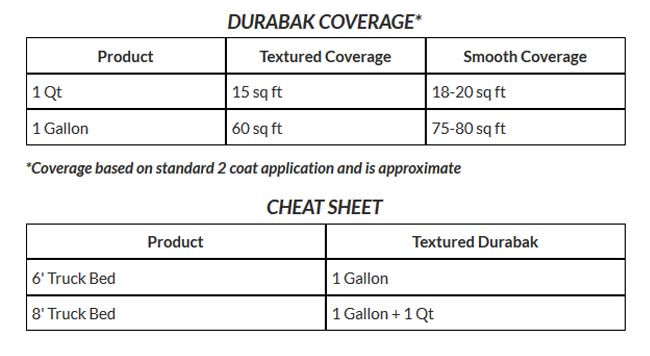
- Coverage (clear coat): 75 sq ft/gal (18 sq ft/qt) at 2 coats, same as the smooth pigmented grade.
Note: 29-39 mils total (2 coats) is the primary DFT figure per the current Durabak Company datasheet. An alternative measured value of 12-18 mils per coat / 24-35 mils total is sourced to the Navy ASTM F-718 (SSPC-PA 2) report and is retained as a secondary reference.
Application Technique
Roller: apply in one direction with moderate pressure. Back-roll lightly at 90 degrees to level the film. Avoid excessive re-rolling of areas that have begun to skin -- pulling the surface disrupts the forming film.
Brush: work in straight passes, laying off at the end of each stroke. Apply two passes at right angles to minimize brush marks.
Airless spray: set inlet pressure 90-100 psi (outlet ~3000 psi). Maintain a consistent 12-in gun distance and overlap passes by 50%. Spray in a dry environment; spray mist in confined areas requires respiratory protection (see Section 12).
Accelerator
The optional cure accelerator (1 packet per quart or per gallon) cuts cure time by up to 50%. Add the accelerator to the liquid coating and stir; do NOT add directly to a spray pot that contains partially cured material. Cured-film performance is unchanged by the accelerator. The accelerator is a separate product with its own SDS (Danger class).
6. Thinning / Reducer
Thinning is not required for most applications and is NOT recommended in confined areas.
When thinning is necessary for spray application or to reduce brushing drag in very warm conditions, use only approved thinners:
- Solvide (Oxsol 100 / Fluidar): VOC-exempt; legal in all 50 states including California and Utah. Preferred reducer for any VOC-sensitive application or jurisdiction.
- Xylene / Xylol: effective reducer; NOT sold to California or Utah customers (state restrictions on the thinner product itself, separate from the coating).
Do NOT thin with generic lacquer thinner, acetone, MEK, or any non-approved solvent. These can disrupt the cure chemistry, cause blushing, or reduce film performance.
Thin only to the minimum necessary for workability. Excessive thinning reduces film build per coat and will require additional coats to achieve target DFT.
Note: the Xylene thinner restriction (CA/UT) applies to the stand-alone thinner product. The Durabak-18 Clear Coat itself contains xylene as a solvent carrier in the formulation (see SDS Section 3).
7. Dry / Recoat / Cure Schedule
Times are at 70 F (21 C) and moderate humidity (~50% RH). Higher temperature and higher humidity shorten these times. Lower temperature and lower humidity lengthen them. Times at other temperatures are approximate; verify by touch and film state.
| Stage | Time at 70 F / 50% RH | Notes |
|---|---|---|
| Working / open time (can after opening) | ~3 hr at 25 C; ~4 hr at 20 C; ~6 hr at 10 C | Reseal can promptly; working time is for material in open tray or spray equipment, not for the sealed can |
| Tack-free / flash-off | 1.5 to 3 hr | Surface is dry enough to touch without transfer |
| Touch dry | ~1.5 to 3 hr | |
| Earliest recoat (light tack state) | ~1 hr minimum | Apply second coat only when first coat is dry to touch and firm underfoot |
| Nominal recoat window | 6 to 12 hr | Optimal intercoat adhesion |
| Maximum recoat without abrasion | 24 hr | After 24 hr, abrade first coat with 80-120 grit before recoating to ensure adhesion |
| Walk on / dry to handle | 6 to 12 hr | Light foot traffic; avoid dragging objects |
| Return to full service | 4 days (full cure; allow longer at cooler temperatures or low humidity) | -- |
| Full cure with accelerator | Up to 50% faster | Times above are without accelerator |
Cure mechanism: atmospheric moisture reacts with the isocyanate groups, releasing CO2 and forming a crosslinked polyurethane membrane. Higher humidity drives faster cure. Do not seal the curing surface from air.
8. Performance and Test Data
Tested Values (with ASTM methods)
| Property | Result | Test Method |
|---|---|---|
| Abrasion resistance | 30.5 mg weight loss | ASTM D4060, Taber wheel, 1000 g load, 1000 cycles |
| Flame spread index | 01 | ASTM E-162 (tested value; not a fire rating) |
| Smoke generation index | 06 | ASTM E-662 (tested value; not a fire rating) |
| Salt spray | No effect | ASTM B-117 / ASTM D-610 |
| Gloss | ~84.7% | ASTM D523 (smooth; M26 smooth measurement; same figure applies to clear coat) |
| Dry time | 6 to 12 hr (ASTM D1640) | ASTM D1640 |
Note: slip resistance is NOT tested or claimed for the clear coat (smooth, no granules). The D1894 and D2047 static coefficient-of-friction values that apply to the textured grade do not apply here.
UV / Weathering
Durabak-18 Clear Coat uses an IPDI aliphatic curative. Aliphatic polyurethanes resist the UV-induced chalking and yellowing characteristic of aromatic systems. Manufacturer data reports gloss loss only (no cracking or checking) after 500-hour QUV accelerated weathering exposure. No independent third-party field UV durability record is available for this specific product.
Chemical Resistance (7-Day Immersion)
Results from the product manual 7-day immersion table. "Excellent" = no visible effect; "Good" = minor effect, acceptable for most uses; "Fair" = moderate effect, limited exposure only; "Poor" = significant effect, avoid contact.
| Chemical / Medium | Resistance Rating | Test Condition |
|---|---|---|
| Potable water | Excellent | 7-day immersion, ASTM D1308 |
| Salt water (100%) | Excellent | 7-day immersion; salt spray ASTM B-117 confirmed no effect |
| Hydrocarbon (HC) fluid | No effect | ASTM D1308 |
| Acids and alkalis (general) | Excellent to Good | 7-day immersion |
| Diesel fuel | Good | 7-day immersion |
| Gasoline | Fair | 7-day immersion; avoid prolonged contact |
| Acetone | Poor | 7-day immersion; avoid contact |
| Concentrated chlorine (bleach) | Discolors if not rinsed | Rinse off immediately; use non-chlorinated cleaners |
For specific chemical exposures not listed, test a cured sample panel under your actual service conditions before committing to a full application.
Additional Performance Properties
- Flexibility: cured film remains flexible at service temperatures; resists cracking and impact without becoming brittle. Does not chip, flake, or peel under normal service conditions.
- Adhesion: chemically bonds to most clean, abraded surfaces (steel, aluminum, concrete, fiberglass, wood, rubber, cured epoxy/primer, and sound painted surfaces). Always test adhesion on a small area of an unfamiliar substrate before full application.
- Repairability: bonds to itself. Spot-repairable by abrading the damaged area and applying a fresh coat. No need to remove sound existing Durabak.
- Water immersion: 7-day water immersion -- no effect (ASTM D1308).
9. Clean-Up
Clean tools, spray equipment, and spills immediately with xylene/xylol or Solvide (Oxsol 100) before the coating cures. Once cured, Durabak is not solvent-removable. Allow solvent-laden rags to dry completely in a well-ventilated area before disposal; solvent-soaked rags can self-heat. Dispose of all solvent waste per local environmental regulations.
10. Storage and Shelf Life
| Parameter | Specification |
|---|---|
| Shelf life (unopened) | 12 months from date of manufacture |
| Storage temperature | 32 F to 104 F (0 C to 40 C) |
| Storage condition | Dry area; sealed tightly. Moisture-cure product: any moisture intrusion into an opened can will initiate cure. Reseal immediately after each use. |
| After opening | Use within the working time window (~3 hr at 25 C). Remaining product in a tightly resealed can may be usable until shelf life expires if oxygen/moisture was minimized. Inspect for skinning or gelation before each use. |
Do not store in locations subject to freezing or prolonged heat above 104 F. Exposure to those extremes can alter viscosity, accelerate pre-cure in the can, or cause the packaging to fail.
11. Packaging and Colors
Packaging
| Size | Notes |
|---|---|
| 1 quart | Use 1 accelerator packet per quart if accelerating |
| 1 gallon | Use 1 accelerator packet per gallon if accelerating |
Colors
Durabak-18 Clear Coat is a single color: Clear / colorless (no pigment). It is optically transparent as a thin film; at full DFT on dark substrates it may show a slight amber cast -- this is characteristic of the resin, not a defect.
For reference, the full Durabak-18 Outdoor/UV pigmented line is available in 15 smooth colors: black, bright red, clear/colorless, cream, dark blue (vivid), dark grey, forest green, light blue, light grey, military olive, orange, sand, tan, white, yellow.
Custom color match (pigmented grades): 75-gallon minimum, lead time required. Colors are also hand-mixable by the user.
12. Limitations and Health & Safety
Limitations
- Not slip-rated. Durabak-18 Clear Coat contains no rubber granules and does not provide a slip-resistant surface. If traction is required, use the textured Durabak-18 Outdoor/UV grade or add an approved anti-skid aggregate to the wet film.
- Not for submerged service. Not recommended for applications permanently below the waterline. Not certified or suitable for potable-water contact or potable-water submersion.
- Not for glass or polished stone. Cannot bond to non-porous surfaces that cannot be mechanically abraded.
- Recoat window. Recoating after 24 hours without abrasion may result in poor intercoat adhesion. Always abrade after the 24-hour window.
- Clear may show substrate defects. Any irregularity in the substrate (rust bloom, previous paint repairs, weld seams) will be visible through the clear film. Prepare the substrate to the final appearance level you want before coating.
- VOC restrictions. Sold in California. CARB SCM-compliant as an Industrial Maintenance coating at <=250 g/L VOC. NOT available in the SCAQMD (greater Los Angeles) district or other air districts that enforce a 100 g/L Industrial Maintenance limit.
- Xylene thinner not sold to CA or UT. Use Solvide (Oxsol 100) as the thinning reducer in those states.
Health and Safety
Flammable liquid. Flash point 27 C (80.6 F), ASTM D56. Keep away from heat, sparks, open flame, and hot surfaces. No smoking during application or until solvent vapors have fully dispersed. Ground and bond metal containers during transfer.
Ventilation. Apply only in well-ventilated areas. Xylene vapor (CAS 1330-20-7) is a central nervous system depressant at elevated exposure levels. At spray mist concentrations IPDI (CAS 4098-71-9), although at a low concentration (0.1-1.0%), may act as a respiratory sensitizer in susceptible individuals. Use forced-air ventilation or supplied-air respiratory protection for spray application in enclosed spaces.
PPE:
- Eyes: chemical splash goggles.
- Skin: chemical-resistant gloves (nitrile or neoprene). Avoid prolonged skin contact; wash immediately with soap and water after any contact.
- Respiratory: for brush/roll in open air, minimum organic vapor respirator (OV cartridge, half-face). For spray application or enclosed spaces: supplied-air respirator or NIOSH- approved supplied-air unit. An N95 dust mask is not adequate for solvent vapors.
- Clothing: long sleeves; launder contaminated clothing separately before reuse.
California Proposition 65 Warning:
WARNING: This product can expose you to ethylbenzene, which is known to the State of California to cause cancer. For more information go to www.P65Warnings.ca.gov.
Consult the SDS. For complete hazard data, first-aid measures, spill response, disposal, and regulatory information, read the full Safety Data Sheet before using this product:
(GHS / OSHA 29 CFR 1910.1200 compliant; covers Durabak-18 Outdoor/UV all finishes, including Clear Coat)
13. Disclaimer / Warranty
All technical information, data, and recommendations contained in this document are based on tests believed to be reliable and are intended to provide guidance for the proper use of Durabak-18 Clear Coat. Actual results may vary depending on substrate condition, surface preparation, application technique, environmental conditions, and the specific service requirements of the user's application.
Durabak makes no warranty, expressed or implied, beyond product conformance to its stated physical specifications at the time of sale. Users are responsible for determining the suitability of this product for their specific application by conducting appropriate tests under their actual service conditions before committing to full-scale use.
This document is a technical guidance reference only. It does not constitute an engineering specification, a building code compliance statement, or a regulatory approval. Regulatory requirements (VOC compliance, fire code, safety) vary by jurisdiction; the user is responsible for compliance with all applicable regulations.
Durabak reserves the right to modify formulations, specifications, and recommendations without notice.
Revision date: 2026-06-18
Version: 1.0